We are in Port Vila for the day, visiting the teacher’s college and the provincial education office for Shefa province and . . . . . visiting the internet café.
Everyone is back from wokabaot now and it was comical to see how happy we all were to be back and see all of our group again. I had mixed feelings coming back, as we all did. I was looking forward to the comfort of being somewhere familiar again, back with my host family in the training village. And it was great to hear about everyone else’s wokabaot experiences. But when I got back to the training village I remembered how noisy it is. Well, relatively noisy. There are lots of barking dogs and crying children at my house in the training village. My new host family doesn’t have barking dogs or crying children. All they have is one extremely rowdy rooster who thinks dawn comes at 3:30 am. And my new host family is great. It’s just hard to go to a place that is all new and kind of start over again.
Once again, I have a really flas (fancy) set up. My host family in the training village is probably the most sophisticated--cement house, flush toilet, inside shower, tile floors, generator, etc. My new host family isn’t that well to do, but they also have a cement house with SCREENS in the windows! Screens! They have lots of fruit and nut trees in the yard and they grow most of their own food--manioc, taro, plantains, coconuts, cabbage, and various frruits that are in season. I have 2 new sisters (one of which lives on Santo with her husband) and 4 new brothers, ages 9 - 22. I’ll try to put up a picture. My host mama knows how to weave the mats and baskets that are so common here so I’m hoping to learn that skill from her. I also have room next to my house for a garden so I’m hoping to get some help with that too while I stay with my host family.
The village where my host family lives is about 20 minutes from the provincial education office in Saratamata and from the house that will be mine eventually. I will live with my host family for the first month at least and then move to Saratamata sometime in January. Both villages are really nice, quite small with grass and trees and nice people. Saratamata also has 4 food stalls (cheap food!) and 4 stores including an ice cream store! And I thought joining the Peace Corps meant deprivation. J Still no hot water so that solar shower the ladies from CCS sent will come in handy! And even though I will have electricity for a part of every day, I won’t have internet access except REALLY SLOW dial-up so I’m not sure how often I will get to update the blog. I will still receive the emails you send to volunteer@vu.peacecorps.gov because the office will send them on but I’ll probably be writing more letters or asking Mom and Dad to post updates for me. And since I will have electricity, those of you who asked about sending movies and music can send away!
So we are back in the training village and actually getting some really helpful training. Kath, you would have laughed to see me today and yesterday. In our sessions yesterday, we made letter identification cards and sight word identification cards so we could test kids when the school year begins again. (Summer vacation here is in December and January.) And today, we colored alphabet cards. We also learned how to make our own books so we could do it for fun or teach the local teachers how to do it so they can write books in the local languages for their classrooms. We’ve also learned how to bake in the all-purpose sauce pans that we use here in Vanuatu and we learned how to use the assessment tools that we made. The best session was a Bislama lesson when our teacher tried to figure out how to translate things like “learner-centered instruction” and “differentiated instruction.” Each of those took about 4 lines of notebook paper to explain.
My Bislama took some pretty good strides forward this week, maybe because I had to use it more. I’ve started picking up the “tune” of Bislama and I don’t have to think as long to translate what I want to say. I was able to talk to my host sister tonight and I understood her. I had trouble understanding her before, I think, because her European language is French rather than English. But then I had to ask my Uncle Savi to slow down and start again when he talked to me right after that. Small steps, I guess.
I guess that’s it for today. I know I write this every time, but I am so grateful to those of you who are writing and emailing and sending packages. I love to hear about what is going on in your lives, the little things as much as the big things. I will post an alternative mailing address for the provincial office in Saratamata but you can use the PMB 9097 address too. The Peace Corps will forward any mail that arrives in Port Vila on to me.
Until next time . . . . .
Wednesday, November 12, 2008

Thursday, October 30, 2008
Wokabaot

Sorry about that last update--I’m not sure what happened.
Here is the latest. . . . .
Placements were announced on Wednesday and I will be going to Ambae (island) and working in the provincial capital of Saratamata. I will be replacing a volunteer who is currently working for the provincial education office and my job description includes teacher observation and coaching, leading workshops, coordinating communication between the provincial education officers and the volunteers, and who knows what else. I am hoping to be able to do some team teaching in the local primary school and to do some curriculum work as well. There’s really no way of knowing exactly what to expect until I get there. The nice thing is that the current volunteer already has some projects going and has made some suggestions about things that need to be done so I feel like I have a head start.
On Saturday, I will leave for my wokabaot to Saratamata and I will be there for a full week before coming back to the training village for three final weeks of technical training. The visit to site is kind of an introduction for me as well as a last check to make sure everything is in order, like housing arrangements. From the information I have received, Saratamata is important as the provincial capital and it has electricity and running water and stores but its population is just over 100 people. It’s hard for me to envision the modern/urban elements with so few people. Most of the people who live there are government workers or nurses or store owners or the like.
Today was a busy day in the training village. We began with a quick debrief about our school visits from the day before; our group visited 5 different places in groups of 2 or 3. It was our second trip to schools where we were able to spend the day observing, and sometimes teaching. It has been really helpful to see the challenges the teachers of Vanuatu face and strategies they use for teaching first hand. Then a short Bislama session where we had to write and tell a story in Bislama and then a trip to the garden. We headed for a garden that has been planted on a slope and talked about strategies for reducing erosion and how to follow the contours of the land when planting and which trees are good for what uses--straight sticks, quick growers, nitrogen sources, invasive species, etc. The last part of the day was spent prepping a village house for a cyclone. We cut coconut palm fronds for the traditional houses (they help hold the roof down) and found concrete bricks and sandbags for the metal roofs. Good practice since it’s cyclone season here from November to April.
We also had a really interesting session with a woman who is working with one of the villages to write down their alphabet. The lower classes at the primary schools are supposed to be taught in the local language, but only some of the villages have that language in print. Janet is working with one of the villages that doesn’t have their language written down yet. She has been working on an alphabet book (A is for apple) for the local language and it was so interesting to hear about the process. She also had some great tips and advice for planning and selecting topics for teacher workshops. Kath, I’ll be calling or emailing for help soon!
The kids here are really amazing. Many of them learn two languages right at the start--the language from their mother’s village and the language from their father’s village. Sometimes they just learn Bislama and sometimes their parents are from the same village so they only learn the one language to start. But there is so little printed material in any of these languages that learning to read is a challenge. Most of their knowledge is obtained aurally. Then, when they get to second or third grade, their classes are taught in either English or French. And when they get a little older, they take the other language as a foreign language. It’s no wonder that literacy skills are low when the kids are learning several languages without learning to be competent and confident readers in their first language. I continue to be amazed by the kids and teachers here. They accomplish so much with so little in the way of resources.
Several people have asked in emails how my Bislama is coming along. I had a couple of low weeks and discouraging sessions with trainers when I was told that my grammar is good but my vocabulary needs a lot of work. I gradually came to realize that, yes, my vocabulary is smaller than it should be, but that is more easily remedied than bad grammar. So, I do not despair. I talked with the class 4 students at the school on Wednesday. They asked me to talk in Bislama rather than English and I seemed to be communicating with them fairly effectively. I took that as a positive sign. Basically, I have been cheating a bit with my Bislama when I talk to English-speakers like my trainers. For example, one trainer asked me, as part of my test, to describe my house in Florida. I used the term “family room” because I knew my trainer would understand it when I should have taken the time to explain what a family room is. That is not a phrase or concept that is readily understood in Vanuatu. So here’s a little sample of Bislama. (I should probably ask one of my trainers to look it over and make sure it’s acceptable but you guys won’t know the difference anyway. :) )
Las Sundei naet, mitrifala trainee i bin mekem piza blong ol host famly blong mitrifala. Lefou (LAY-fow) (aka Katie) wetem Turtong (aka Sandy) wetem mi (Lairipu lay-rrrri-poo --my kastom name which means “woman farmer“) bin pem ol ingrediens long Port Vila long Satadei. Mitrifala i bin pem floao mo yist mo tomato mo capsicum mo salami mo jis blong mekem siks piza. Mitrifala i bin kuk ol piza long oven blong bred mo hemi bigfala oven. Olgeta 6 piza fitim insaed long oven long sem taem. Ol host famly blong mitrifala oli laekem piza blong mitrifala tumas. Olgeta oli askem mitrifala mekem piza bekagen nara taem.
Translation: “Last Sunday night, three of us trainees made pizza for our host families. Katie, Sandy, and I bought the ingredients in Port Vila on Saturday. We bought flour, yeast, tomatoes, peppers, salami, and cheese to make 6 pizzas. We cooked the pizzas in the bread oven and it’s a big oven. All 6 pizzas fit inside at one time. Our host families really liked the pizza. They asked us to make it again another time.”
There is a lot of English in Bislama. The challenge is the limited vocabulary. It makes a language that was developed TO BE functional, really inconvenient to use.
The pizza part is a true story and here’s another one. One morning before I left for school, there was a great uproar of dogs in the backyard. I went back there to get some hot water from the kitchen and discovered that several of the chief’s pigs (I learned they were his pigs later) had escaped from their pen and the dogs were trying to herd/corral them for the chief. I think the dogs got a little carried away (there must have been 5 or 6 of them chasing the pig) because several of them bit into various parts of the pig, supposedly to hang on to it and not just because their primitive selves got the better of them. (I’m giving them the benefit of the doubt here.) Anyway, the dogs were barking and growling and yelping and charging through the grass after the pigs that were snorting and squealing and charging through the grass, all of them being chased by two men with sticks who were yelling and shouting at the pigs and dogs, and there were several mamas in the kitchen watching the chaos and shouting encouragements and directions and laughing at the men and the dogs and the pigs. And then, as the roiling mass of animals passed by my host father’s pig pen, one of the bigger pigs inside the fence decided to enter the fray. It used one of the other pigs in the pen as a ramp and leaped over the fence to get at the dogs. And the mamas started laughing even harder and the men shouted louder and now there were two big pigs instead of one big pig and it was a wild couple of minutes.
Here is the latest. . . . .
Placements were announced on Wednesday and I will be going to Ambae (island) and working in the provincial capital of Saratamata. I will be replacing a volunteer who is currently working for the provincial education office and my job description includes teacher observation and coaching, leading workshops, coordinating communication between the provincial education officers and the volunteers, and who knows what else. I am hoping to be able to do some team teaching in the local primary school and to do some curriculum work as well. There’s really no way of knowing exactly what to expect until I get there. The nice thing is that the current volunteer already has some projects going and has made some suggestions about things that need to be done so I feel like I have a head start.
On Saturday, I will leave for my wokabaot to Saratamata and I will be there for a full week before coming back to the training village for three final weeks of technical training. The visit to site is kind of an introduction for me as well as a last check to make sure everything is in order, like housing arrangements. From the information I have received, Saratamata is important as the provincial capital and it has electricity and running water and stores but its population is just over 100 people. It’s hard for me to envision the modern/urban elements with so few people. Most of the people who live there are government workers or nurses or store owners or the like.
Today was a busy day in the training village. We began with a quick debrief about our school visits from the day before; our group visited 5 different places in groups of 2 or 3. It was our second trip to schools where we were able to spend the day observing, and sometimes teaching. It has been really helpful to see the challenges the teachers of Vanuatu face and strategies they use for teaching first hand. Then a short Bislama session where we had to write and tell a story in Bislama and then a trip to the garden. We headed for a garden that has been planted on a slope and talked about strategies for reducing erosion and how to follow the contours of the land when planting and which trees are good for what uses--straight sticks, quick growers, nitrogen sources, invasive species, etc. The last part of the day was spent prepping a village house for a cyclone. We cut coconut palm fronds for the traditional houses (they help hold the roof down) and found concrete bricks and sandbags for the metal roofs. Good practice since it’s cyclone season here from November to April.
We also had a really interesting session with a woman who is working with one of the villages to write down their alphabet. The lower classes at the primary schools are supposed to be taught in the local language, but only some of the villages have that language in print. Janet is working with one of the villages that doesn’t have their language written down yet. She has been working on an alphabet book (A is for apple) for the local language and it was so interesting to hear about the process. She also had some great tips and advice for planning and selecting topics for teacher workshops. Kath, I’ll be calling or emailing for help soon!
The kids here are really amazing. Many of them learn two languages right at the start--the language from their mother’s village and the language from their father’s village. Sometimes they just learn Bislama and sometimes their parents are from the same village so they only learn the one language to start. But there is so little printed material in any of these languages that learning to read is a challenge. Most of their knowledge is obtained aurally. Then, when they get to second or third grade, their classes are taught in either English or French. And when they get a little older, they take the other language as a foreign language. It’s no wonder that literacy skills are low when the kids are learning several languages without learning to be competent and confident readers in their first language. I continue to be amazed by the kids and teachers here. They accomplish so much with so little in the way of resources.
Several people have asked in emails how my Bislama is coming along. I had a couple of low weeks and discouraging sessions with trainers when I was told that my grammar is good but my vocabulary needs a lot of work. I gradually came to realize that, yes, my vocabulary is smaller than it should be, but that is more easily remedied than bad grammar. So, I do not despair. I talked with the class 4 students at the school on Wednesday. They asked me to talk in Bislama rather than English and I seemed to be communicating with them fairly effectively. I took that as a positive sign. Basically, I have been cheating a bit with my Bislama when I talk to English-speakers like my trainers. For example, one trainer asked me, as part of my test, to describe my house in Florida. I used the term “family room” because I knew my trainer would understand it when I should have taken the time to explain what a family room is. That is not a phrase or concept that is readily understood in Vanuatu. So here’s a little sample of Bislama. (I should probably ask one of my trainers to look it over and make sure it’s acceptable but you guys won’t know the difference anyway. :) )
Las Sundei naet, mitrifala trainee i bin mekem piza blong ol host famly blong mitrifala. Lefou (LAY-fow) (aka Katie) wetem Turtong (aka Sandy) wetem mi (Lairipu lay-rrrri-poo --my kastom name which means “woman farmer“) bin pem ol ingrediens long Port Vila long Satadei. Mitrifala i bin pem floao mo yist mo tomato mo capsicum mo salami mo jis blong mekem siks piza. Mitrifala i bin kuk ol piza long oven blong bred mo hemi bigfala oven. Olgeta 6 piza fitim insaed long oven long sem taem. Ol host famly blong mitrifala oli laekem piza blong mitrifala tumas. Olgeta oli askem mitrifala mekem piza bekagen nara taem.
Translation: “Last Sunday night, three of us trainees made pizza for our host families. Katie, Sandy, and I bought the ingredients in Port Vila on Saturday. We bought flour, yeast, tomatoes, peppers, salami, and cheese to make 6 pizzas. We cooked the pizzas in the bread oven and it’s a big oven. All 6 pizzas fit inside at one time. Our host families really liked the pizza. They asked us to make it again another time.”
There is a lot of English in Bislama. The challenge is the limited vocabulary. It makes a language that was developed TO BE functional, really inconvenient to use.
The pizza part is a true story and here’s another one. One morning before I left for school, there was a great uproar of dogs in the backyard. I went back there to get some hot water from the kitchen and discovered that several of the chief’s pigs (I learned they were his pigs later) had escaped from their pen and the dogs were trying to herd/corral them for the chief. I think the dogs got a little carried away (there must have been 5 or 6 of them chasing the pig) because several of them bit into various parts of the pig, supposedly to hang on to it and not just because their primitive selves got the better of them. (I’m giving them the benefit of the doubt here.) Anyway, the dogs were barking and growling and yelping and charging through the grass after the pigs that were snorting and squealing and charging through the grass, all of them being chased by two men with sticks who were yelling and shouting at the pigs and dogs, and there were several mamas in the kitchen watching the chaos and shouting encouragements and directions and laughing at the men and the dogs and the pigs. And then, as the roiling mass of animals passed by my host father’s pig pen, one of the bigger pigs inside the fence decided to enter the fray. It used one of the other pigs in the pen as a ramp and leaped over the fence to get at the dogs. And the mamas started laughing even harder and the men shouted louder and now there were two big pigs instead of one big pig and it was a wild couple of minutes.
I'm sorry there are no pictures this time. I tried to upload a couple and in 15 minutes, none of my pictures has appeared. I don't have any more time today. I'll try again another day.
Many thanks to those of you who have been emailing and sending packages. It makes a huge difference to be able to hear what is going on in your lives and not feel so cut off! Miss you all. I'll write again when I get the chance--not sure when that will be!
Thursday, October 9, 2008
Life in PST


Me in my "aelan dres," a gift from my host parents. This is my host mother, Anies.
Two weeks in our training village have flown by. We arrived on a Sunday afternoon, quite anxious to meet our host families and get a first look at the village. And our first action was to walk back out of the village so we could be properly welcomed. The boys in the village had planned a traditional welcome and, as we walked back into the village, they stormed out of the bushes dressed in custom camouflage (bushes and twigs wrapped around their bodies) and brandishing sticks. It was a bit unnerving actually. After terrifying us properly, they led us to meet the chief. Our host mamas formed a receiving line and we all got bussed on both cheeks and a lei without knowing which mother belonged to which trainee.
The village itself is mostly corrugated metal houses or cinderblock homes with corrugated roofs. There are about 30 compounds and 260 people. My host family has been wonderful. My host father, Sael, is quite the entrepreneur. He owns a tour bus, a taxi, a stereo system that he rents out for parties, and is building a tourist bungalow on the beach nearby. We have electricity at night by generator and water in the house. He is working on an indoor bathroom, complete with flush toilet, but it isn’t finished yet.
My mama, Anies, has been really patient with me as I practice my Bislama. It takes me 2 minutes to figure out how to phrase my idea and several false starts to actually get it out. However, I understand most of what is said to me so that’s progress. What is need is a lot of written practice to get the words and rhythms into my head. Bislama is, in many ways, a very simple language. The vocabulary is fairly limited and many words have English roots or they’re exactly the same. The sentence structure is straightforward though it takes some getting used to. There are no possessives in Bislama. You have to say “the house that belongs to me” anytime you want to say “my.” “Haos blong me hemi naransaed long solwater.” It can make for some very long sentences!
I have three host brothers and sisters: Juliette is 13 and attends French school. She is quite bright and hopes to pass her examinations next year to get into secondary school. Places in secondary schools in Vanuatu are very limited so the 8th class year is known as the “push out” because many students don’t score well enough on their examinations to earn a place. Gloria is 8 and also attends French school, but in the village, and Micah is 4 and has a mind of his own. He will go to English school beginning in January.
It is hard to explain how quickly the extraordinary becomes routine but after two weeks, I am taking some things for granted. I still don’t like using the “smal haos” but I’m used to the food and walking everywhere and dodging the mangoes that are falling from the trees and sitting on the ground or hard benches (not many cushions around) and brushing my teeth at the outdoor spigot and waving the flies off of my dinner and the dogs and the chickens and the pigs and . . . . .
Actually, our village is pretty spiffy. I think every compound has a water tap so no hauling water. Lots of families have generators. There’s a wide variety of food available because the families have gardens, we’re right near the ocean for fishing, and the capital city is close by for any extras. During the first week of November, we will go on “wokabaot” to visit our permanent sites. It will be another transition, I think, to an even simpler way of living. It all depends . . . . Actually, it sounds like some of us may end up in slightly more developed areas because we’ll be working with provincial directors and not just with individual schools. The head honchos at Peace Corps haven’t told anyone their sites but we’re supposed to find out next week.
We have classes every week day--Bislama lessons first, then sessions on the education system in Vanuatu, presentations by people in the education ministry here, presentations about Vanuatu’s economy and areas for growth, sessions on how to write lesson plans J , disucssions with current volunteers about secondary projects, presentations about what to do in case of cyclone . . . volcanic eruption . . . . landslide . . . . bush fire . . . . etc, etc, etc. The best classes though are the practical ones. Yesterday, we learned how to make mango jam and coconut jam. We also spent one afternoon building fires, scraping and squeezing coconut for the cream, killing chickens, and making “simboro,” a traditional dish made from manioc.
I am getting more excited and more nervous about my permanent site--how will I be received (sometimes the village doesn’t know you’re coming!), whether it will be easy to find projects or whether I will have to invent them, what my village will be like. We visited two schools today and have talked with a variety of people who could offer us some insight on what the future might hold. The challenges sound enormous but there is also so much potential for growth and improvement.
I've got to sign off--time to head for the office and the bus ride back to the training village. I'll try to get more pictures on next time. Check again in two weeks!
Thursday, September 25, 2008
Rats, Snails, and Worms
First a technical message:
volunteer@vu.peacecorps.gov
Rachel Meiste in the subject line . . . . will get to me on a weekly basis. (The medical team is going to come out once a week for training sessions and they said they would bring our mail.)
We’ve had two more days of training/classes and most of them were spent on medical issues. One afternoon, we packed and discussed the contents of two tool-kit type medical containers. We have several kinds of pain killers, several kinds of antibiotics, several kinds of washes or creams or ointments, bug spray, sun screen, cotton balls, band aids, steri strips, gauze pads, oral rehydration tablets, water treatment tablets, even a malaria testing kit (lancet included). I had to keep reminding myself that this was all “just in case” something happened. We also received a handbook put together by the medical office to help us self-diagnose and self-treat and a book called Where There is No Doctor: A Village Healthcare Handbook that is designed for the whole world. There are some pretty interesting diseases and treatments in there, let me tell you!
And today we had a session on food and water safety and all the things you can experience if your food or water isn’t safe. The funny thing is that most of the diseases, worms, bacteria, viruses, etc that we may be exposed to all have similar symptoms and many of them (the viruses) just have to go through their cycle. There’s nothing you can do except treat the symptoms. Somehow that doesn’t make me feel better. But again, I am a relatively healthy person, not particularly prone to accidents, and most volunteers we’ve talked with haven’t been sick more than once or twice in the year or year and a half they’ve been here. Quite reassuring.
Everyone has been holding up pretty well so far, I think, though the ipods and books and journals are appearing more often. People come to sit in the communal area in the courtyard but they come equipped with signs that this is personal time. Probably a good thing. Generally speaking, we are with other trainees from at least 8 am to 5pm and usually much longer than that since we’re not encouraged to go places by ourselves. Most trainees do something in the evening--a trip to a nakamal for kava, a movie at a downtown restaurant, dinner at a restaurant or a trip to the market. It is rare that we have or take advantage of time alone in our rooms.
In the next few days, however, we’ll definitely be spending more time in our rooms as we unpack and repack all of our belongings. It is a matter of deciding what to bring to the training village, home for the next 10 weeks, and what can stay here for the time being. Some of our things can stay in storage here in Port Vila, but the suggested packing list is fairly long and it includes things we’ll need for our “wokabaot” to our permanent sites. It sounds like we come back to the capital city 2 or 3 times during training but I think they are scheduled outings. No telling how much free time we’ll have to unpack and repack the stuff in storage.
I’m also getting some more ideas for the wish list--things that I didn’t think to bring until I got here or things that I thought I wouldn’t need but have reconsidered. Things like Gatorage mix packets. After drinking the green coconut milk (a rehydration miracle fluid, according to PC nurses) and the rehydration solution provided in our medical kits, I will be happy to mix up some Gatorade instead.
Our first official Bislama lesson is tomorrow, complete with practice trip to the market to talk with the “mamas” who are there. The Peace Corps often uses the hotel where we are staying and the ladies who work here have begun to ask us more things in Bislama as well. They are really nice about helping us with our new vocabulary. “Olsem wanem?” (“How are you?”) “I stret.” (“I stret” translates something like “It’s all good.”) Bislama actually uses a lot of English words or words that were originally English, but they’re written phonetically so they look different, like “wokabaot.” “Yu oraet?” would be another example. Any guesses? (“ae” is pronounced long “i” like “sight”). They do have multipurpose prepositions which are confusing to me but the trainers promise to do everything they can to help us become conversant/comfortable speaking Bislama in the 10 weeks of training.
Friday, September 26
Opening your mouth to try a new language for the first time, outside of the safe class environment is a pretty intimidating moment. We went to the market today, a field trip, to try out our first Bislama. The lessons this morning were really interesting. We started with pronunciation and then some basic sentence structures. Susan S., you would LOVE the phonetics of this language! I kept wishing you were here listening in. The mamas at the market were very forgiving and I only tried out a few phrases--”Mi wantem wan raep mango, plis.” and “Wanem nem blong ia?”(What name belongs to this?) One group of ladies was laughing at my pitiful attempts to pronounce an unfamiliar fruit but what can we do but laugh at our neighbors and be laughed at in our turn (I paraphrase J).
Tomorrow is our cooking class in the morning and water safety in the afternoon. It is supposed to rain all afternoon so our water excursion should be interesting. Then we pack up and leave for our training village where we will be for the next 10 weeks. There was a possibility that our host mamas and papas would be at the market today, but I didn’t meet mine. That will have to wait until Sunday. We are supposed to come back to Port Vila a few times during training so I hope to be able to update again in a couple of weeks.
volunteer@vu.peacecorps.gov
Rachel Meiste in the subject line . . . . will get to me on a weekly basis. (The medical team is going to come out once a week for training sessions and they said they would bring our mail.)
We’ve had two more days of training/classes and most of them were spent on medical issues. One afternoon, we packed and discussed the contents of two tool-kit type medical containers. We have several kinds of pain killers, several kinds of antibiotics, several kinds of washes or creams or ointments, bug spray, sun screen, cotton balls, band aids, steri strips, gauze pads, oral rehydration tablets, water treatment tablets, even a malaria testing kit (lancet included). I had to keep reminding myself that this was all “just in case” something happened. We also received a handbook put together by the medical office to help us self-diagnose and self-treat and a book called Where There is No Doctor: A Village Healthcare Handbook that is designed for the whole world. There are some pretty interesting diseases and treatments in there, let me tell you!
And today we had a session on food and water safety and all the things you can experience if your food or water isn’t safe. The funny thing is that most of the diseases, worms, bacteria, viruses, etc that we may be exposed to all have similar symptoms and many of them (the viruses) just have to go through their cycle. There’s nothing you can do except treat the symptoms. Somehow that doesn’t make me feel better. But again, I am a relatively healthy person, not particularly prone to accidents, and most volunteers we’ve talked with haven’t been sick more than once or twice in the year or year and a half they’ve been here. Quite reassuring.
Everyone has been holding up pretty well so far, I think, though the ipods and books and journals are appearing more often. People come to sit in the communal area in the courtyard but they come equipped with signs that this is personal time. Probably a good thing. Generally speaking, we are with other trainees from at least 8 am to 5pm and usually much longer than that since we’re not encouraged to go places by ourselves. Most trainees do something in the evening--a trip to a nakamal for kava, a movie at a downtown restaurant, dinner at a restaurant or a trip to the market. It is rare that we have or take advantage of time alone in our rooms.
In the next few days, however, we’ll definitely be spending more time in our rooms as we unpack and repack all of our belongings. It is a matter of deciding what to bring to the training village, home for the next 10 weeks, and what can stay here for the time being. Some of our things can stay in storage here in Port Vila, but the suggested packing list is fairly long and it includes things we’ll need for our “wokabaot” to our permanent sites. It sounds like we come back to the capital city 2 or 3 times during training but I think they are scheduled outings. No telling how much free time we’ll have to unpack and repack the stuff in storage.
I’m also getting some more ideas for the wish list--things that I didn’t think to bring until I got here or things that I thought I wouldn’t need but have reconsidered. Things like Gatorage mix packets. After drinking the green coconut milk (a rehydration miracle fluid, according to PC nurses) and the rehydration solution provided in our medical kits, I will be happy to mix up some Gatorade instead.
Our first official Bislama lesson is tomorrow, complete with practice trip to the market to talk with the “mamas” who are there. The Peace Corps often uses the hotel where we are staying and the ladies who work here have begun to ask us more things in Bislama as well. They are really nice about helping us with our new vocabulary. “Olsem wanem?” (“How are you?”) “I stret.” (“I stret” translates something like “It’s all good.”) Bislama actually uses a lot of English words or words that were originally English, but they’re written phonetically so they look different, like “wokabaot.” “Yu oraet?” would be another example. Any guesses? (“ae” is pronounced long “i” like “sight”). They do have multipurpose prepositions which are confusing to me but the trainers promise to do everything they can to help us become conversant/comfortable speaking Bislama in the 10 weeks of training.
Friday, September 26
Opening your mouth to try a new language for the first time, outside of the safe class environment is a pretty intimidating moment. We went to the market today, a field trip, to try out our first Bislama. The lessons this morning were really interesting. We started with pronunciation and then some basic sentence structures. Susan S., you would LOVE the phonetics of this language! I kept wishing you were here listening in. The mamas at the market were very forgiving and I only tried out a few phrases--”Mi wantem wan raep mango, plis.” and “Wanem nem blong ia?”(What name belongs to this?) One group of ladies was laughing at my pitiful attempts to pronounce an unfamiliar fruit but what can we do but laugh at our neighbors and be laughed at in our turn (I paraphrase J).
Tomorrow is our cooking class in the morning and water safety in the afternoon. It is supposed to rain all afternoon so our water excursion should be interesting. Then we pack up and leave for our training village where we will be for the next 10 weeks. There was a possibility that our host mamas and papas would be at the market today, but I didn’t meet mine. That will have to wait until Sunday. We are supposed to come back to Port Vila a few times during training so I hope to be able to update again in a couple of weeks.
Monday, September 22, 2008
Here in Vanuatu

I had a whole update typed up and saved on my flashdrive, but this computer can't read it so this is my best attempt at a lot of information in a few minutes.
We arrived in Port Vila, Vanuatu on Saturday, having missed Friday entirely. The time here is 16 hours ahead of the east coast, USA. We have found it easier to add 8 hours to our time and then remember it's actually the day before on the east coast. So it is 5:15 Tuesday evening here in Port Vila and (8 hours ahead would be) 1:15 am on the east coast, but Monday night/Tuesday morning. Got that?
We arrived in Port Vila, Vanuatu on Saturday, having missed Friday entirely. The time here is 16 hours ahead of the east coast, USA. We have found it easier to add 8 hours to our time and then remember it's actually the day before on the east coast. So it is 5:15 Tuesday evening here in Port Vila and (8 hours ahead would be) 1:15 am on the east coast, but Monday night/Tuesday morning. Got that?
 This is the airport in Port Vila. We "deboarded" to really nice weather, cool (by my definition) and breezy. The PeaceCorps volunteers were waiting for us, you can see the people above the airport waiting and watching from behind the fence. The volunteers met us outside the airport after we cleared customs in a receiving line. We were given leis, a coconut with straw for the milk, a lava lava (the traditional wrap), and a name tag as we traveled down the row. See image below. :)
 Port Vila's essence is not hard to imagine if you have visited a Caribbean country and actually toured or walked the areas where people live, not just the resort or tourist areas. The main roads are paved in the city but outlying areas have crushed coral roads, most of the buildings are made of cinder blocks and are one story tall, though there are exceptions. Shrubs and trees grow where ever they can. The roads are really busy during the "rush hour" times with minivans that are buses or taxis and pedestrians walking to work or the nearest bus stop. Other times of the day, the roads are pretty empty which is nice because the drivers don't give you a lot of space as a pedestrian. The bougainvillea and hibiscus are blooming but the smell is of fire. There is always a faint smell of smoke in the air because many people here burn their trash.
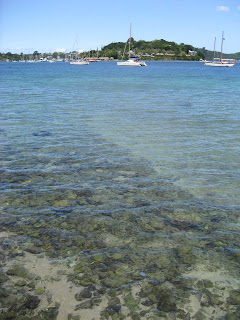
This is a picture of a small portion of the main road through Port Vila. The road follows the curve of the harbor and is never far from the water. Most of the businesses are closed on Saturday afternoons and Sundays (when this picture was taken). The second picture is a view of Irriyikki Island (not sure about the spelling) which is a resort island in the harbor.

Several of the other trainees and I spent our free time on Sunday walking around the city. In the afternoon, we went to our country director's house for a tea. We got to try a number of local fruits--soursop is a fruit that is fleshly kind of like a pear but tastes more like citrus and pampamousse is a lot like grapefruit only not as tart. We got to sample our first traditional foods on Monday during our first day of training. The PC staff laid out quite a spread for us. We had lots of fresh fruit, including pampamousse and mango and several kinds of bananas. There was pumpkin with coconut milk, taro with coconut milk, curried fish and roasted fish (a whole BIG one), barbecued beef filets, potato salad made with yams and purple potatoes, coleslaw, and the traditional Vanuatu dish, lap lap. Lap lap is a little bit like a pasty or meat pie. There are vegetables or meat inside of a shell but the outside is thicker than crust. It's more like mashed potatoes spread around the meat only it's made from manioc or taro or plantain. It was delicious.
Today was the day for shots--4 of them today. I'll have to come back for 3 more in a few months, finishing up the heptatis series. Other than getting over the jet lag, those have been the only low points. :)
I have lots more to write, but I need to conserve my internet cafe minutes. Hopefully I will be able to figure out a way to type up my posts on my computer and paste them here. I'll be able to say a lot more that way!
Monday, September 15, 2008
TIME TO GO!
My flight will be leaving from the Sarasota airport tomorrow at 3:55 and I'm either overpacking or underbagging. My bed is covered with assorted things that somehow didn't make it into the two bags I've packed. So far three people have weighed in with opinions--2 for "bring another bag" and 1 for "do what you think is best." I have to say that I'm torn between making sure everything fits (and having room for a couple of spare items) and the fear that I'm overdoing it--that my American materialism is overriding my better judgement. It is also important to keep in mind that I have to carry everything I bring, probably several times and in less than smooth conditions. There is still time to cast your vote--dial 1 for "bring another bag," 2 for "cut back on the goods," and 3 for "do what you think is best." The winner will be announced the next time I am able to update.
I will be bringing a computer after all. Communications from the Peace Corps regarding mail mentioned that expensive items have a tendency to get misplaced when they have to go through the postal system/customs in Vanuatu so my original plan to 'get there and see if a computer would be helpful' had to be thrown out. Depending on my placement, the computer will come with me and be a handy, helpful tool or it will be put into storage in Port Vila for use when I am there. So much depends on the placement.
The last two weekends were spent visiting with Florida friends and family. One weekend, I was in Ft. Lauderdale visiting with my friend Elizabeth and her family. The next weekend was spent with my sisters, brother-in-law, and parents. We had a great time visiting the beach and kayaking and playing lawn volleyball.
Many thanks to all of you who have called or emailed or commented here on the blog. I so appreciate all of your encouragement and support.
See you again in 27 months or so!
I will be bringing a computer after all. Communications from the Peace Corps regarding mail mentioned that expensive items have a tendency to get misplaced when they have to go through the postal system/customs in Vanuatu so my original plan to 'get there and see if a computer would be helpful' had to be thrown out. Depending on my placement, the computer will come with me and be a handy, helpful tool or it will be put into storage in Port Vila for use when I am there. So much depends on the placement.
The last two weekends were spent visiting with Florida friends and family. One weekend, I was in Ft. Lauderdale visiting with my friend Elizabeth and her family. The next weekend was spent with my sisters, brother-in-law, and parents. We had a great time visiting the beach and kayaking and playing lawn volleyball.
Many thanks to all of you who have called or emailed or commented here on the blog. I so appreciate all of your encouragement and support.
See you again in 27 months or so!
Friday, August 29, 2008
A summary of the last two weeks
Flagler Beach--My timing was poor, but I was able to spend a couple of days with Kathryn and Andrew in Flagler Beach . . . during Tropical Storm Fay. I drove across Florida as the storm was moving north and hit the first rain just east of Orlando. We spent the next two days holed up at Kath's (except for Andrew who got called in to work at the firehall) while Fay took her sweet time moving north directly over Flagler Beach. We did have a small window of time to take a walk when the eye passed over, but otherwise we were fairly housebound. The storm itself wasn't that bad in Flagler Beach, fairly steady rain and wind but nothing too ferocious, but most other places were closed. Fortunately, there was plenty for us to do. We spent one evening in the attic going through all of Kath's school boxes looking for books and worksheets and seminar notes on literacy development in elementary school. I spent the next two days going through stacks of materials, taking notes and learning about phonemic awareness, vocabulary building, sight words, and how to turn silly songs into learning tools. What have I gotten myself into?
Chattanooga--I spent four days in Chattanooga visiting with friends, subbing for a day, and refereeing a volleyball scrimmage. It was a little strange to be back at CCS without a classroom and a to-do list but it was nice to sit in Susan's office and chat with whoever came in. Subbing for Jeannette in the art room was a reminder that it will be good to take some time off from teaching--the power had gone out that morning and the kids were . . . stimulated by the excitement and there is nothing in the art room to absorb sound. :) It was great, though, because Jeannette's classes are primarily 8th grade so I could visit with my former students and not worry too much about whether the work was getting done. And the volleyball teams look great though it was hard to leave at the end of practice. Those senior girls have been part of my life for 6 years now. (I'll miss you!)
I didn't get a lot of emotional support from the faculty about going to Vanuatu. Apparently, the nobility of joining the Peace Corps has been undermined by the scenic beauty of my future site and my perceived level of sacrifice has dropped. That's ok. Just wait until I get there. I'll post a picture of the biggest cockroach ever seen crawling across the wall of my tropical hut and see if that doesn't change perceptions of my blissful life in paradise. Actually, the Peace Corps sent a booklet on adjusting to the new life and culture and work and it was a very good reminder of what kinds of challenges do await. They started with the weather, which I hope to enjoy (except for all of that rain) but there were some great tips in there about how I will appear to my future co-workers and how tiring it is to learn a new place when you can't escape from it. Everything will be new and that is exhuasting. I plan to bring the handy little book along and will probably be consulting it frequently just as a reminder that [whatever phase of frustration I am passing through at the moment] too shall pass.
Vanuatu--My departure is set for September 16. I will fly to LA for a day and a half of introductions and some basic training. We leave in the evening on the 19th from LA and we arrive in Vanuatu on the 22nd, bright and EARLY. It doesn't actually take 2 full days; we're crossing the international dateline from the 21st into the 22nd.
Lonely Planet published a guidebook about Vanuatu and the Bradenton downtown library happened to have it so we've been reading up. It sounds like the rainiest months are the first ones we spend at our actual sites--January through March--so that will be interesting. LP also said that the primary schools are conducted in English or French and Bislama is reserved for the playground. I hadn't realized that from the basic info the Peace Corps sent. I thought the primary schools were conducted either in the local language or in Bislama and the kids also had to learn the European language. That makes the information I got from Kath that much more helpful since it probably won't have to be translated or modified for Bislama. And that means that the people I work with in the ministry of eduation will probably have at least a working knowledge of English or with people who speak French. The Bislama will help me in my village and in the capital city at the markets and such.
I have collected most of the things I hope to bring. (The flashlight arrived, Susan S.! It works wonderfully.) Whether it will fit into my bags and weigh less than 80 pounds in total is another issue, but at least it's all gathered in one spot. I figure I can mail a box of extras and books if I want to. Speaking of which, I have a mailing address for the 10 weeks I will be in training. If you would like to get in touch with me (PLEASE DO!), you can either email me through my gmail account or send things to the mailing address.
or send regular mail to:
Rachel Meiste
Peace Corps/Vanuatu
PMB 9097
Port Vila
Republic of Vanuatu
And once I am at my site, I will arrange for a local mailing address but I won't know what that is until sometime in December.
I have been working on a wish-list if anyone should be inclined to send a package. I feel a little presumptuous, but nobody has to use it, right? I'll try to figure out how to post it along the right side of the page and I'll put the mailing/emailing info there too so it's easy to find. Just in case. :)
Flagler Beach--My timing was poor, but I was able to spend a couple of days with Kathryn and Andrew in Flagler Beach . . . during Tropical Storm Fay. I drove across Florida as the storm was moving north and hit the first rain just east of Orlando. We spent the next two days holed up at Kath's (except for Andrew who got called in to work at the firehall) while Fay took her sweet time moving north directly over Flagler Beach. We did have a small window of time to take a walk when the eye passed over, but otherwise we were fairly housebound. The storm itself wasn't that bad in Flagler Beach, fairly steady rain and wind but nothing too ferocious, but most other places were closed. Fortunately, there was plenty for us to do. We spent one evening in the attic going through all of Kath's school boxes looking for books and worksheets and seminar notes on literacy development in elementary school. I spent the next two days going through stacks of materials, taking notes and learning about phonemic awareness, vocabulary building, sight words, and how to turn silly songs into learning tools. What have I gotten myself into?
Chattanooga--I spent four days in Chattanooga visiting with friends, subbing for a day, and refereeing a volleyball scrimmage. It was a little strange to be back at CCS without a classroom and a to-do list but it was nice to sit in Susan's office and chat with whoever came in. Subbing for Jeannette in the art room was a reminder that it will be good to take some time off from teaching--the power had gone out that morning and the kids were . . . stimulated by the excitement and there is nothing in the art room to absorb sound. :) It was great, though, because Jeannette's classes are primarily 8th grade so I could visit with my former students and not worry too much about whether the work was getting done. And the volleyball teams look great though it was hard to leave at the end of practice. Those senior girls have been part of my life for 6 years now. (I'll miss you!)
I didn't get a lot of emotional support from the faculty about going to Vanuatu. Apparently, the nobility of joining the Peace Corps has been undermined by the scenic beauty of my future site and my perceived level of sacrifice has dropped. That's ok. Just wait until I get there. I'll post a picture of the biggest cockroach ever seen crawling across the wall of my tropical hut and see if that doesn't change perceptions of my blissful life in paradise. Actually, the Peace Corps sent a booklet on adjusting to the new life and culture and work and it was a very good reminder of what kinds of challenges do await. They started with the weather, which I hope to enjoy (except for all of that rain) but there were some great tips in there about how I will appear to my future co-workers and how tiring it is to learn a new place when you can't escape from it. Everything will be new and that is exhuasting. I plan to bring the handy little book along and will probably be consulting it frequently just as a reminder that [whatever phase of frustration I am passing through at the moment] too shall pass.
Vanuatu--My departure is set for September 16. I will fly to LA for a day and a half of introductions and some basic training. We leave in the evening on the 19th from LA and we arrive in Vanuatu on the 22nd, bright and EARLY. It doesn't actually take 2 full days; we're crossing the international dateline from the 21st into the 22nd.
Lonely Planet published a guidebook about Vanuatu and the Bradenton downtown library happened to have it so we've been reading up. It sounds like the rainiest months are the first ones we spend at our actual sites--January through March--so that will be interesting. LP also said that the primary schools are conducted in English or French and Bislama is reserved for the playground. I hadn't realized that from the basic info the Peace Corps sent. I thought the primary schools were conducted either in the local language or in Bislama and the kids also had to learn the European language. That makes the information I got from Kath that much more helpful since it probably won't have to be translated or modified for Bislama. And that means that the people I work with in the ministry of eduation will probably have at least a working knowledge of English or with people who speak French. The Bislama will help me in my village and in the capital city at the markets and such.
I have collected most of the things I hope to bring. (The flashlight arrived, Susan S.! It works wonderfully.) Whether it will fit into my bags and weigh less than 80 pounds in total is another issue, but at least it's all gathered in one spot. I figure I can mail a box of extras and books if I want to. Speaking of which, I have a mailing address for the 10 weeks I will be in training. If you would like to get in touch with me (PLEASE DO!), you can either email me through my gmail account or send things to the mailing address.
or send regular mail to:
Rachel Meiste
Peace Corps/Vanuatu
PMB 9097
Port Vila
Republic of Vanuatu
And once I am at my site, I will arrange for a local mailing address but I won't know what that is until sometime in December.
I have been working on a wish-list if anyone should be inclined to send a package. I feel a little presumptuous, but nobody has to use it, right? I'll try to figure out how to post it along the right side of the page and I'll put the mailing/emailing info there too so it's easy to find. Just in case. :)
Subscribe to:
Posts (Atom)